
The clunk you hear is geometry coming loose.
A control arm holds the wheel where the engineers put it. When its bushings soften and its ball joint wears, the wheel starts moving a little on its own, and the vehicle changes character so slowly that most owners never notice until the tires give it away.
- Open 24 hours, seven days
- No hourly minimum
- A real number before we roll
- Cars, pickups, vans, work trucks
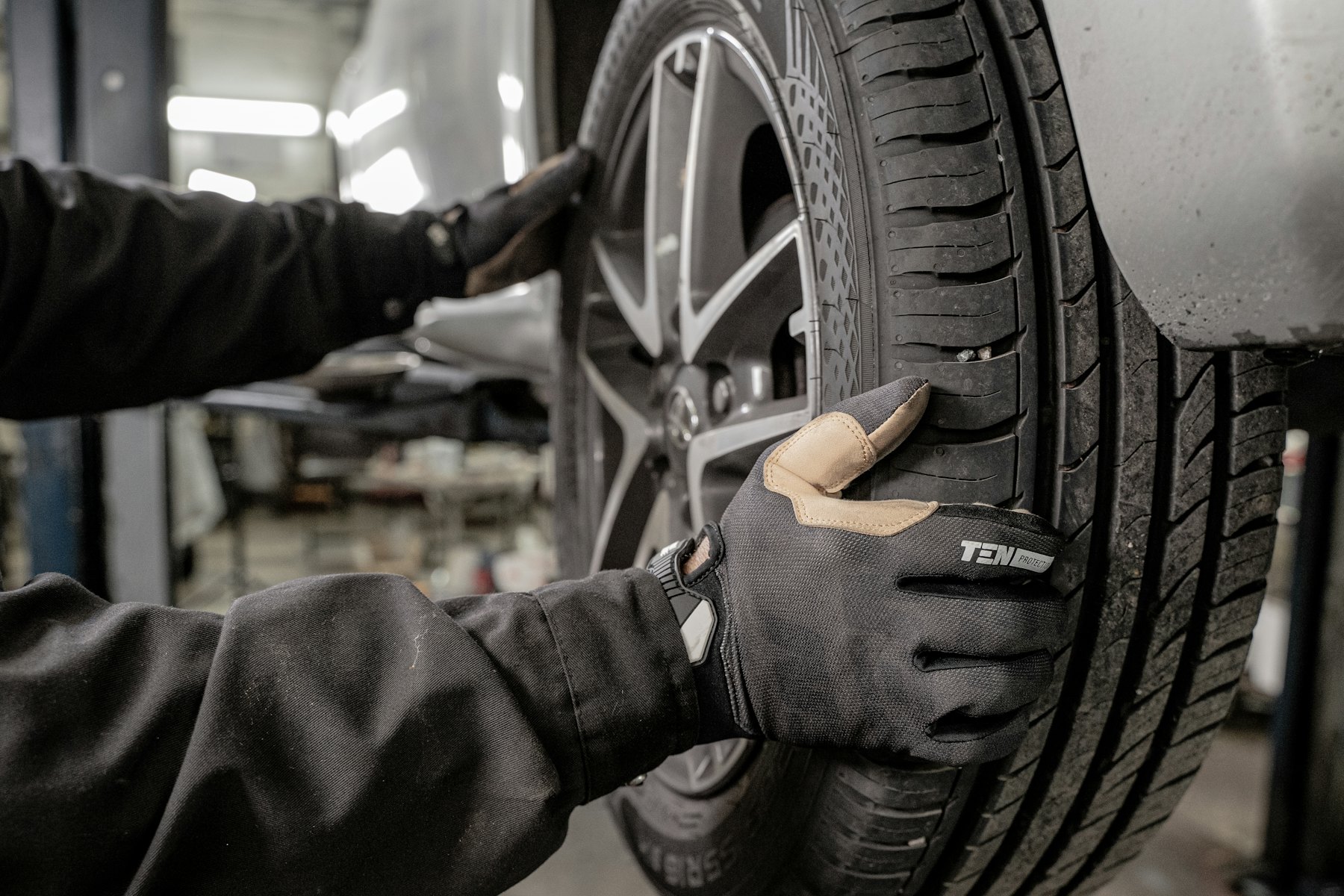
What the arm actually does, and what wears out on it
A control arm is a hinged link between the frame and the wheel assembly. It has to hold the wheel at a fixed angle while letting it travel up and down over bumps, which means it needs joints at both ends. At the frame end, rubber or polyurethane bushings. At the wheel end, usually a ball joint.
The arm itself almost never fails. It is a stamped or cast piece of metal and it outlives everything attached to it, barring a serious pothole or a collision. What fails is the rubber and the joint, and they fail on completely different schedules for completely different reasons.
Bushings die of age and chemistry as much as mileage. Rubber hardens, cracks and eventually tears away from its sleeve, helped along by heat, oil and time. A vehicle parked outside for fifteen years can have shot bushings with very few miles on it. Once they tear, the arm can shift slightly under load, so the wheel’s angle changes every time you accelerate, brake or corner.
Ball joints die of wear and contamination, and they follow the same story as any other sealed joint on a vehicle: the boot splits, the grease leaves, dirt arrives, and the polished surfaces inside grind themselves loose. The difference is the consequence. A badly worn lower ball joint can separate, and when that happens the wheel folds under the vehicle.
Symptoms worth reportingA hollow clunk over bumps or speed bumps, vague steering that follows ruts in the road, a shudder under braking, or tire edges wearing faster than the middle.
The figureWhat the job runs is agreed before a tool comes out, and no clock runs underneath it.
Covered groundHome base is American Canyon, with Napa and Solano as the core and the wider Bay counties reachable when it makes sense. Look at the map.
Tire wear is the symptom people notice last
Most owners come to this repair through noise, because a clunk is hard to ignore. The quieter version costs more, and it shows up as rubber.
When bushings soften, the wheel’s camber and toe stop being fixed values and start being ranges. The tire spends its life at a slightly wrong angle, and worse, at an angle that changes under load. So one shoulder of the tread carries more than its share and wears away while the rest of the tire looks fine. Run a hand across it and the wear is uneven from inner edge to outer.
The other tell is alignment that will not hold. A shop sets the angles correctly on the rack, the vehicle drives well for a few weeks, and then the pull or the wander comes back. That is worn bushings letting everything move again the moment real load goes through the suspension. Nobody did the alignment wrong. It was measured on a component that cannot hold a setting.
So if you have paid for two alignments in a year and the second one did not stick, the front arms are worth inspecting before you buy a third.
Whole arm or just the joint, said honestly
This is the real decision on the job, and the answer is genuinely different from vehicle to vehicle. Here is how we work through it with you.
- Sometimes the choice is made for youPlenty of modern arms come with the ball joint riveted or pressed in as a permanent part of the assembly. On those, the complete arm is the only sanctioned repair, and anybody offering to press a joint into an arm not built for it is inventing a procedure.
- Pressed bushings need a pressReplacing bushings alone means driving the old ones out and the new ones in under real force, squarely, without damaging the housing. That is shop equipment and a bench, not something to attempt at a curbside with hand tools. Pretending otherwise is how a bushing goes in crooked and fails inside a year.
- Complete arms are usually the mobile answerA new arm arrives with bushings and joint already fitted and correctly seated. It unbolts and bolts back on, which is work we can genuinely do at your location to a proper torque figure. The part costs more than a bushing kit and it saves the press, the bench and a second visit.
- The economics are not always in favor of the cheap partOn an older vehicle where both bushings and the joint are worn, a separate joint plus a bushing kit plus the labor to press them can land near the price of the complete arm, with more ways to go wrong. We will tell you when that is the case, even though the bigger part sounds like the bigger sale.
- Do both sides when it makes senseArms wear in pairs because they have the same age and the same road under them. If one side is clearly finished and the other is close, doing both now costs one setup and one alignment instead of two.
Whatever we recommend, you hear the reasoning and what each route costs before anything is ordered.
If the cheaper part is the wrong answer for your vehicle, we would rather lose the sale than sell you a repair that comes back.
Patrick Freeman, owner
Neighbors that make the same noises
A front end clunk has several possible authors, and the arm is only one of them. These get checked before anything is recommended.
Steering system diagnostics
The starting point when the complaint is how the vehicle drives rather than a specific noise you can place.
Shock replacement
Worn dampers and failed top mounts knock over bumps too, and they change how the vehicle settles.
Tie rod replacement
Play in the steering linkage produces its own looseness, often on the same corner as a tired arm.
Wheel bearing replacement
A hub complaint arrives as noise that rises with road speed rather than as a knock over bumps.
Work truck repair
Loaded front ends on service vehicles eat suspension parts, and the truck earns nothing while it waits.
Mobile auto repair
What else gets handled at your home, yard or jobsite instead of at a shop counter.
Questions about control arms
Something we have missed? Ring the number and ask.
How urgent is a worn ball joint?
More urgent than most suspension wear, and this is the one place we push people. A ball joint that separates lets the wheel fold under the vehicle, and that happens without warning and at whatever speed you happen to be doing. Slight wear found on inspection is usually something you can schedule within a week or two. Visible movement at the joint, or a clunk that has arrived recently and is getting worse, means park it and call.
Can you do this at my house or yard?
Yes, with a caveat about the ground. We need somewhere level and solid to lift the vehicle and hold it securely while the arm is unloaded, so a flat driveway, a yard or a paved jobsite is fine and soft dirt or a slope is not. Complete arm replacement is well suited to working on location. Pressing bushings into an existing arm is not, and we will say so rather than improvise.
Do I need an alignment afterward?
Yes. Replacing an arm changes where the wheel sits, so the angles have to be reset on a rack afterward, and we do not perform alignment out of a service truck. We get the vehicle back together properly so the drive to the shop is safe and short, and we tell you what was replaced so the alignment technician knows what they are working with.
Why did my new alignment stop holding?
Usually because something underneath it is still moving. An alignment sets angles on the components as they are on the day, so if a bushing is torn or a joint is worn, the setting is accurate for about as long as it takes for real load to go through the suspension again. Sorting the worn parts first and aligning afterward is the order that actually sticks.
Should I replace both sides at once?
Not always, but it is worth pricing. Arms on the same axle have shared an age and a road, so when one is finished the other is often not far behind. Doing both together means one lift, one teardown and one alignment rather than repeating all of it in a few months. If the second side genuinely has life left, we will say so and leave it.
Are aftermarket arms any good?
They range widely, which is the honest answer. There are aftermarket arms that match the original in materials and joint quality, and there are cheap ones with soft rubber and a ball joint that will be loose again inside two years. We buy from lines we have had good service from and we will tell you what we are fitting. On a work truck that earns its living, paying a little more for the better part is almost always the cheaper decision.
Worth sorting before it changes your tires.
Tell us where the noise comes from, what the tire edges look like, and whether an alignment has already failed to hold. That is usually enough to bring the right arms out on the first trip. A number and an arrival window come back on the same call.
HoursMonday to Sunday, 24 hours
Based inAmerican Canyon, CA
Front end workShocks · Wheel bearings · Work we have done · Get hold of us